News
Dependability through comprehensive manufacturing capabilities



From Bow Lathe to Multi-Axis Powerhouse: The 5,000-Year Evolution of CNC Lathes
Lathes are mainly machine tools that use turning tools to turn rotating workpieces. Drills, reamers, taps, die and knurling tools can be used for processing on lathes. They are mainly used to process shafts, discs, sleeves and other workpieces with rotating surfaces, which are the most widely used machine tools in machinery manufacturing and repair factories.
So how did the lathe evolve?
Now, follow TMT to learn about the evolutionary history of "lathes"!
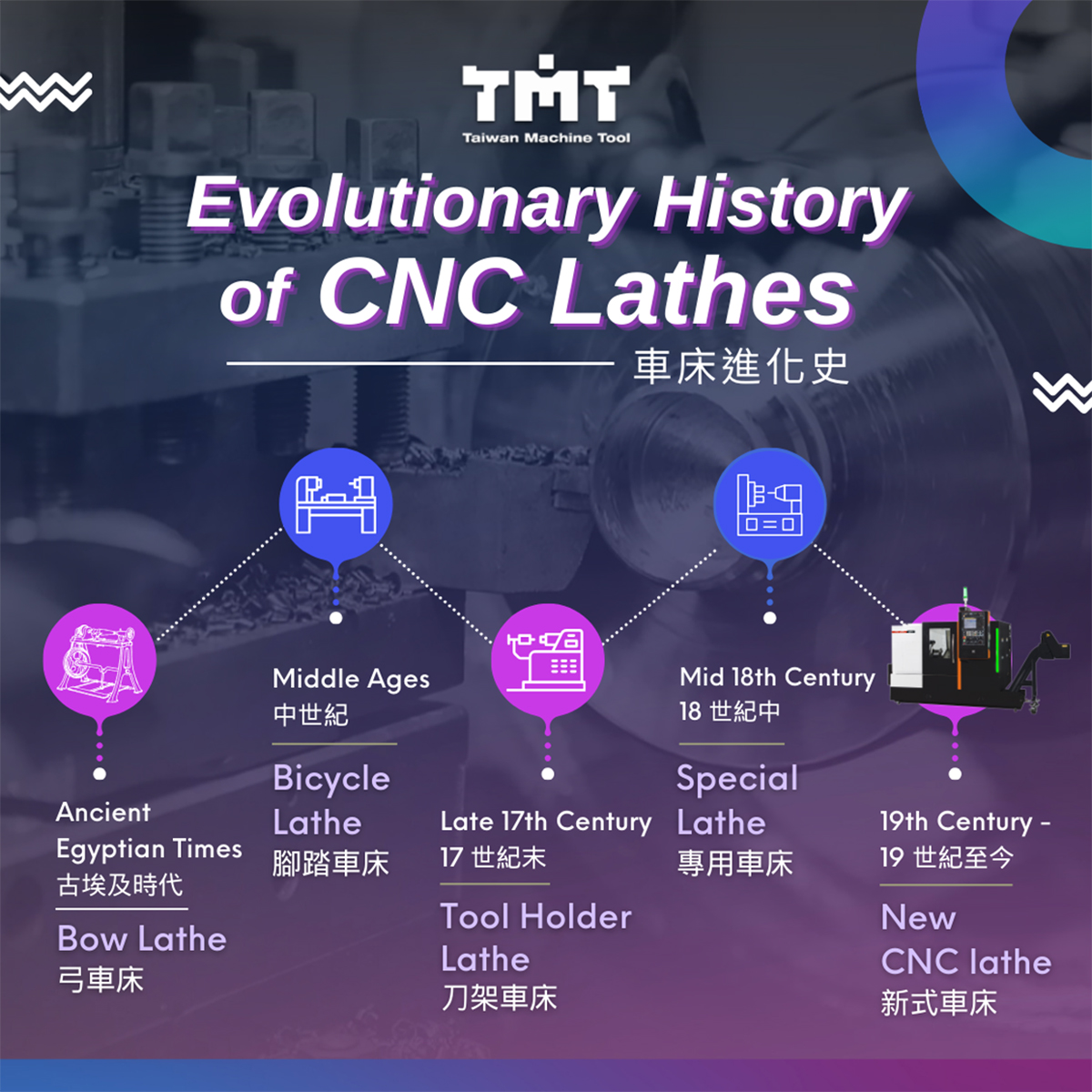
- Ancient Egyptian Times—"Bow Lathe"
At that time, people invented the technology of rotating wood around a central axis and turning it with a tool. Later, it developed into winding a rope two or three times around a pulley. The rope was placed on an elastic rod bent into a bow shape. The bow was pushed and pulled back and forth to rotate the processed object to perform turning. That is "bow lathe“ - Medieval Times—"Bike Powered Lathe"
At this time, a Bike Powered Lathe appeared that used a pedal to rotate the crankshaft and drive the flywheel, which was then transmitted to the spindle to rotate it. - The end of the 17th century - the epoch-making "tool rest lathe"
This lathe has a precision lead screw and interchangeable gears. Maudslay made the first screw-cutting lathe in 1797. The tool holder and tailstock move along two parallel guideways. The surfaces of the guideway is triangular in shape. When the spindle rotates, it drives the screw to move the tool holder laterally. It is the main structure of modern lathes and can turn precision metal screws of any pitch. Soon after, Maudslay built a more complete lathe with interchangeable gears to change the feedrate and pitch of the thread being processed. - Mid-18th century - "Special lathe" improves mechanization and automation
In 1845, Fitch of the United States invented the turret lathe, and three years later, the return lathe appeared; in 1873, Spencer of the United States made a "single-axis automatic lathe", and then a "three-axis automatic lathe"; At the beginning of the 20th century, lathes with gear transmissions driven by separate motors appeared. Due to the invention of high-speed steel and the application of electric motors, lathes were continuously improved and reached the modern level of high speed and high precision. - From the 19th century to the present—"New Lathes" such as CNC and multi-axis
After World War I, due to the needs of the arms, automobiles and other machinery industries, lathes evolved from simple numerical control systems to computer numerical control, and were expanded to other metal processing machines; Japan then broke away from the traditional spindle form of machine tools, using a spider-foot-like device to move the machine tool spindle and controlling it with a high-speed controller, creating a faster, multi-axis new machine tool!