News
Dependability through comprehensive manufacturing capabilities


Comparison and Impact of Spindle Lubrication Methods
The spindle lubrication method directly affects spindle stability, service life, accuracy, and maintenance cost. Here is a comparison of several common spindle lubrication methods and their impact.
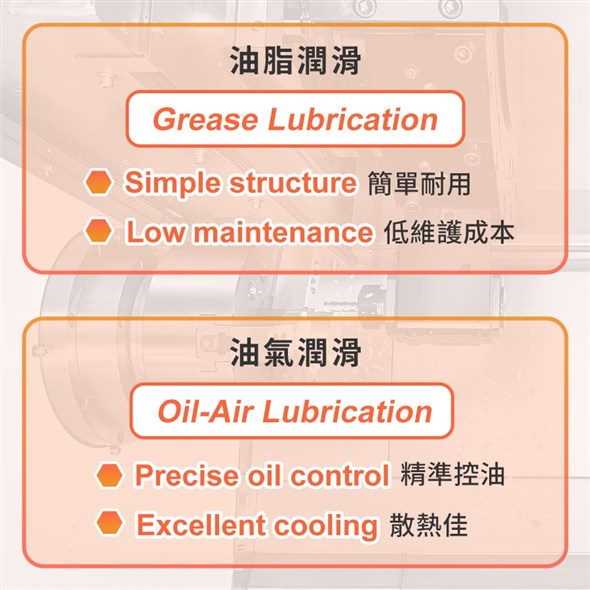
1. Grease Lubrication
Principle: The bearings are pre-filled with an appropriate amount of grease, which distributes itself as the bearing rotates.
Features:
- Simple structure, no additional lubrication system required.
- Suited to low and medium speed applications, such as general CNC lathes and milling machines.
- Low maintenance needs; long grease life supports stable long-term operation.
- Poorer heat dissipation, so it is not suited to high-speed, high-load applications.
- Higher drag than oil lubrication, resulting in greater friction loss.
Impact: Suited to lower speeds (generally below 10,000 rpm), standard machining, and general precision machinery.
2. Oil-Air Lubrication
Principle: A small amount of lubricating oil is carried to the bearings by compressed air, forming a thin oil film and carrying away part of the heat.
Features:
- Suited to high-speed applications such as high-speed machining centers, grinders, and precision spindles (up to 60,000 rpm).
- Even lubrication with controllable oil quantity, reducing oil waste.
- Excellent heat dissipation, effectively lowering bearing temperature.
- High system cost, requiring additional oil-air supply equipment.
- Requires regular maintenance to keep the oil-air system unobstructed.
Impact: Suited to ultra-high-speed spindles. It extends spindle life and improves machining accuracy while reducing friction and heat, but equipment cost is higher.
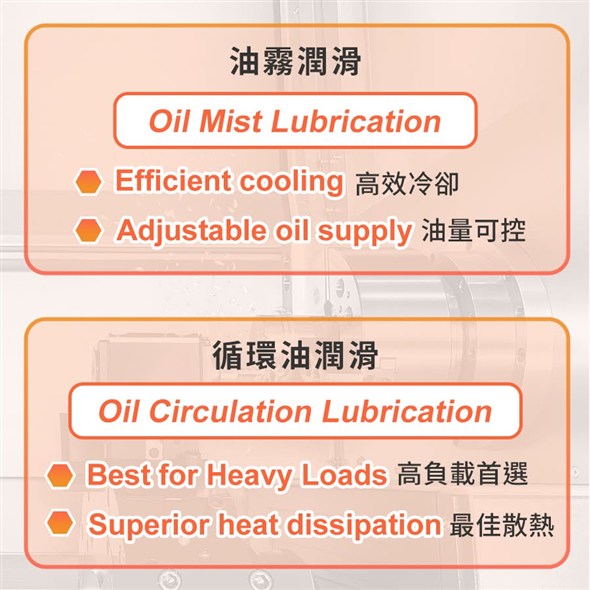
3. Oil Mist Lubrication
Principle: Compressed air atomizes the lubricating oil and sprays it into the bearings, forming an oil film for lubrication.
Features:
- Good cooling, suited to medium and high speed spindles.
- Adjustable oil quantity, reducing lubricant consumption.
- Excellent lubrication, reducing bearing friction and wear.
- Greater environmental impact, as oil mist pollution may occur.
- The system requires regular maintenance to ensure a stable oil mist supply.
Impact: Suited to medium and high speed machines (such as high-speed CNC lathes and grinders). It extends spindle life and improves accuracy, but oil mist recovery and environmental protection measures must be considered.
4. Oil Circulation Lubrication
Principle: A pump supplies lubricating oil to the spindle bearings, and the oil is cooled and then recirculated.
Features:
- Best cooling performance, effectively lowering spindle operating temperature.
- Suited to heavy-load and high-speed applications (such as large milling machines, grinders, and turn-mill machines).
- Long spindle life with continuous, stable lubrication.
- High system cost, requiring an additional oil pump and cooling equipment.
- Lubricating oil must be replaced regularly, increasing maintenance cost.
Impact: Suited to high-precision, high-rigidity machines, ensuring stable spindle operation, but with higher cost and maintenance requirements.